The Appaloosa.
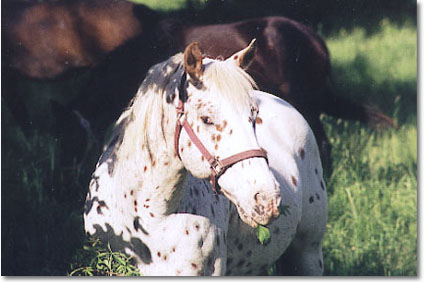
Leopard spotted
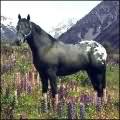
Of all the breed's characteristics the one that shouts most loudly is the horse's coat pattern. Basically this falls into two main categories: leopard and blanket. Three other kinds of basic pattern complete the palette: marble, snowflake and frost markings. Within these five patterns there are subdivisions and within these again an infinite variety. No two Appaloosas are ever marked the same. To complicate matters there are also Appaloosas that have no coat pattern whatsoever but do have other Appaloosa characteristics, and even more bewildering there are some that show none of the above, being completely solid in colour, yet are of Appaloosa breeding. This Factor has given rise to a tremendous amount of controversy within some of the breed associations, and is the main point of divergence when it comes to the type of papers the animal is issued with.
Conformation
ideals
The overall appearance of the Appaloosa should be symmetrical.
The head should be straight and lean, ears pointed and medium sized. Lips, muzzle,
nostrils and the area around the eyes generally show parti-coloured skin. The
eyes should preferably be dark, although there is no discrimination against registering
an animal with blue eyes. Eyes should be surrounded with white sclera. The neck
should show quality, with a clean-cut throat latch and large windpipe. The chest
should be deep, shoulders well muscled, long and sloping, and withers well defined.
The back is short and straight, loin short and wide, quarters well rounded. The
underline is long with the flank well let down. Hips are long, sloping and muscular,
running into muscular long thighs; gaskins are also long, wide and muscular, and
hocks are clearly defined, wide and straight. Forelegs should be straight, and
from the front a perpendicular line should run from point of shoulder through
knee, cannon, pastern and hoof. From the side a perpendicular line should run
from the centre of the elbow joint through knee, pastern and fetlock joints to
the back of hoof. The hind legs should have a perpendicular line from the quarter
through the centre of hock, cannon, pastern and foot. From the side a perpendicular
line should fall from the hip joint to the centre of the hoof, dividing the gaskin.
A perpendicular line from the point of the quarter should run parallel with the
line of the cannon bone. There is no maximum height, and different associations
have minimum height rules. Weight should be in proportion to height.
Colouring.
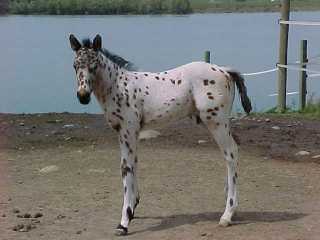
True
leopard colouring is when a foal is born leopard and carries the spots throughout
his life.
Near leopard, born with leopard spots but has solid face and/or legs
.
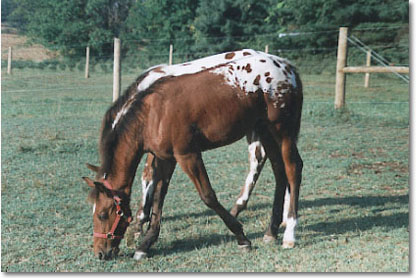
Spotted blanket.
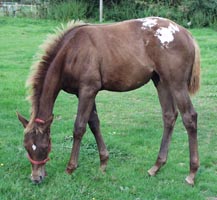
Lace blanket.
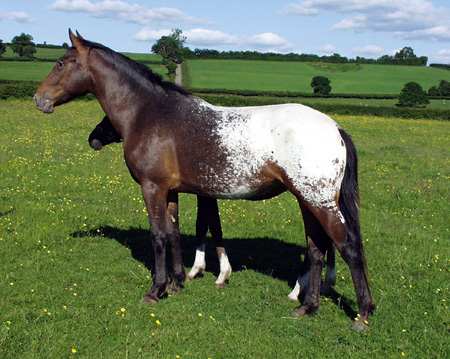
The snowflake pattern.
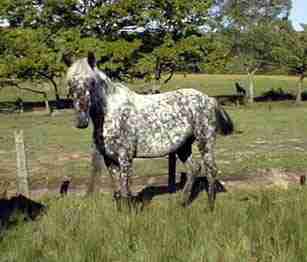
Frosted
Frosted:
The frosted Appaloosa has a dark base colour and either a light sprinkling of
frost or small snowflakes on hip, loin and rump which may extend forwards in the
manner of a blanket.
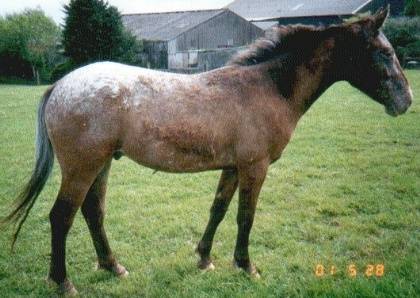
Frosted
Few spot leopard. The solid colours will gradually disappear with age.
Other
characteristics:
To be considered an Appaloosa for most registries,
the horse must also exhibit some of the following, with differences according
to registry. A white sclera surrounds the eye. This is the most noticeable of
the characteristics. There should be mottled skin on the muzzle, around the eyes
and in the genital area. The hooves are often striated with bands of dark and
pale coloured laminae. Appaloosa horses are noted for the superior quality of
hoof horn. The last visible characteristic is that some horses have a very sparse
mane and tail, although most are well endowed.
Discplines
The
Appaloosa horse has been used in every discipline, dressage, show jumping, long
distance, cross country, with great success both here and abroad. They are very
versatile animals.